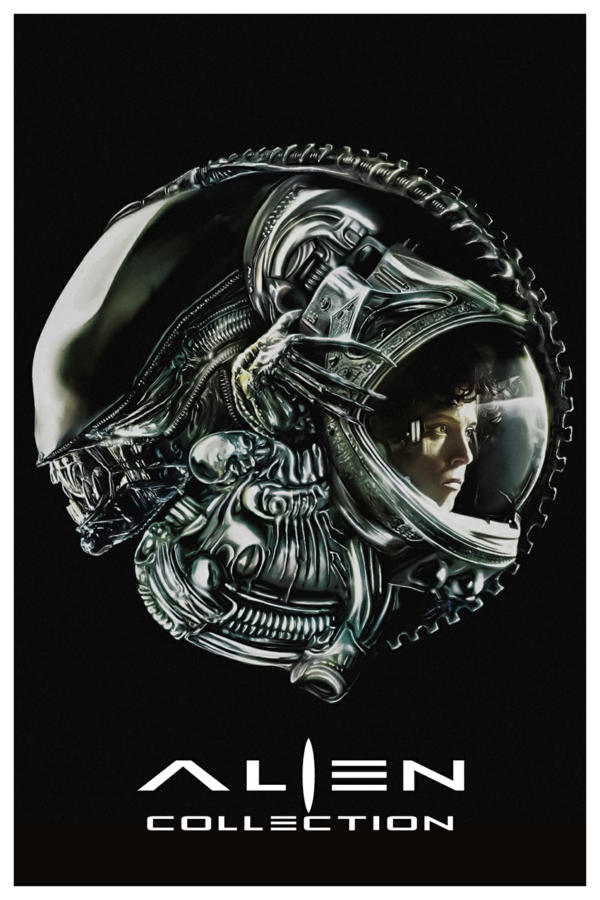
Alien Collection
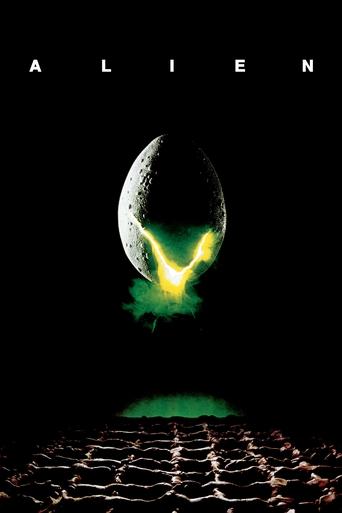
6 films See all 6 films ↓Dan O'Bannon and Ronald Shusett pitched this as "Jaws in space," and for a while that description was the only thing getting anyone's attention — the finished script went nowhere until low-budget horror producer Roger Corman showed interest, before it eventually landed at a production house with ties to 20th Century Fox. One specific, genuinely consequential choice in that script: O'Bannon wrote every character without a specified gender, noting explicitly that any role could be cast either way. That's what actually opened the door for Ripley to be a woman at all — not a predetermined feminist statement baked into the character from page one, but a writing decision that handed Ridley Scott the freedom to cast an unknown actress, Sigourney Weaver, in what the script itself never assumed would be a man.
The design is where this film actually earns its reputation, and it's worth knowing how deliberate it was. O'Bannon discovered Swiss surrealist H.R. Giger's "biomechanical" artwork — fusions of organic bodies and industrial machinery — and brought him on specifically to design the creature, the derelict ship, and the alien planetoid. The sexual content in those designs wasn't incidental or accidental: Giger and the filmmakers built the imagery explicitly around phallic and vaginal forms, turning the whole film into what's since become a standard subject for academic film criticism — the chestburster sequence read directly as a nightmare inversion of childbirth, male violation anxiety given a literal, monstrous body.
That sequence has its own specific, very human origin, too: O'Bannon suffered from Crohn's disease, and his own experience with it directly shaped the idea of something violently erupting from inside a person's body. On set, the cast knew structurally what the scene involved but weren't told how graphic the effect itself would be, so their visible shock is largely real — Veronica Cartwright's reaction in particular came from an actual spray of blood hitting her when the puppet burst through John Hurt's chest, not direction to act startled.
Made for $11 million and grossing over $100 million, it turned into one of the most consequential horror productions of its decade on the strength of specific, documented choices — a script's quiet unwillingness to assume gender, an artist's willingness to make a monster explicitly sexual rather than just frightening, and a crew's choice to get a genuine reaction rather than a performed one.